GDPR compliance is non-negotiable for businesses using AI tools in sales. Non-compliance can lead to heavy fines, legal actions, and loss of consumer trust. By 2025, GDPR fines reached €5.88 billion, with regulators increasingly using AI to detect violations. Key takeaways:
To stay compliant, map data flows, set up robust consent mechanisms, and minimize data collection. Tools like Salesforge offer GDPR-friendly features like centralized consent management and secure data handling, helping businesses meet regulatory standards while maintaining efficient outreach.

GDPR Compliance Statistics and Fines for AI Sales Tools 2025
The General Data Protection Regulation (GDPR) outlines key principles that dictate how AI sales tools should handle personal data. These principles apply whether you're using AI sales tools for lead scoring, customizing outreach, or automating follow-ups via email or LinkedIn.
Lawfulness ensures that data processing has a valid legal basis. For AI sales tools, this means securing separate legal justifications for training AI models and running sales campaigns. Currently, most B2B outreach relies on "legitimate interest", but by 2026, regulators are expected to require explicit consent for cold outreach in the EU.
Transparency mandates that prospects must clearly understand how their data is being used. Emails should explicitly state who is contacting them and the reason behind the outreach. Failing to provide this clarity can lead to hefty penalties.
Data minimization limits data collection to only what is necessary. Just because AI can gather extensive behavioral data doesn't mean it should. For sales workflows, this often means sticking to professional details like names, job titles, and company information, rather than delving into personal browsing habits or inferred sensitive data.
Purpose limitation prohibits using data for purposes beyond its original intent. For instance, if you collect an email address for one campaign, you can't automatically enroll the prospect in unrelated marketing efforts without obtaining new consent.
Accountability requires organizations to document every data processing decision and maintain detailed audit trails to demonstrate compliance. You can also use free sales tools to audit your current outreach for deliverability and compliance risks.
"GDPR doesn't say 'Don't send cold emails'. It says, 'If you send cold emails, respect personal data, and have clear reasons for outreach'." - lemlist team
Behavioral data, such as tracking email engagement, monitoring LinkedIn interactions, and AI-driven lead scoring, comes with additional GDPR protections that go beyond basic contact details.
Article 22 gives individuals the right not to be subjected to decisions based solely on automated processing, including profiling, if those decisions significantly affect them. For example, if your AI tool automatically disqualifies prospects or prioritizes leads without human oversight, you could be in violation unless you have explicit consent or a contractual necessity.
The right to explanation allows prospects to ask why an AI made certain decisions about them. If your system labels someone as a "hot lead" based on behavioral signals, you must be able to explain that reasoning in simple terms.
Data Protection Impact Assessments (DPIAs) are required under Article 35 when AI systems engage in large-scale behavioral monitoring.
A particular risk involves inferred special category data. If your AI starts drawing conclusions about a prospect's health, political beliefs, or other sensitive characteristics based on their behavior, explicit consent is mandatory. Regular audits of your AI's inferences are crucial to avoid these violations.
Understanding these requirements helps clarify the specific roles involved in data processing, which we'll explore next.
When working with AI sales tools, it's essential to understand the roles defined by GDPR. These roles come with specific responsibilities, and using third-party platforms does not shift your accountability.
The data controller is your sales organization. You decide which prospects to target, craft the messages, and determine when campaigns are launched. Even if you use tools like Salesforge, you remain the decision-maker responsible for the purpose and methods of data processing.
The data processor is the AI sales platform that processes data on your behalf. For example, platforms like Salesforge manage automation and mailbox functions but don't decide whom to contact or why.
Data subjects are your prospects - the individuals whose personal information is processed. They have rights under GDPR, such as accessing their data, correcting inaccuracies, and requesting deletion.
| Role | Primary Responsibility | Key GDPR Requirement |
|---|---|---|
| Data Controller | Decides who to email and why; selects the AI tool | Must provide a legal basis (e.g., legitimate interest or consent) and ensure transparency |
| Data Processor | Handles data on behalf of the controller | Must follow the controller's instructions and implement strong security measures |
| Data Subject | The prospect whose data is processed | Has rights to access, correct, delete, and request explanations |
Controllers are required to conduct Legitimate Interest Assessments (LIA), keep records of data sources, and document the legal basis for each contact. If something goes wrong, you can't simply blame your AI tool - regulators will hold you accountable for choosing a non-compliant processor.
"Under the GDPR, the personal data you collect should be adequate and relevant to the purpose of its processing (Principle c: Data Minimisation)." - Dan Vanrenen, Managing Director, Taskeater
When a prospect requests data deletion, you're responsible for ensuring their information is removed from all systems, including backups - not just your active mailing list.
(function(d,u,ac){var s=d.createElement('script');s.type='text/javascript';s.src='https://a.omappapi.com/app/js/api.min.js';s.async=true;s.dataset.user=u;s.dataset.campaign=ac;d.getElementsByTagName('head')[0].appendChild(s);})(document,372145,'tu1or50rqqejh816h1cm');
Start by mapping out every point where personal data enters and exits your workflow. This includes data from website forms, LinkedIn profiles, purchased lead lists, and CRM imports. Track the journey of this data - whether it’s heading to AI processing tools, third-party databases, or email automation platforms.
To stay organized, create a Records of Processing Activities (RoPA) document. This should detail the types of data you collect (like names, email addresses, IP addresses, and behavioral signals), why you’re collecting it, and your legal basis for doing so. For B2B outreach, this often involves conducting a Legitimate Interest Assessment (LIA) to confirm that your business needs don’t outweigh individuals’ privacy rights. With 92% of companies relying on customer databases, automated tools for mapping data flows have become crucial.
Gone are the days when manual audits were enough. Regulators now expect continuous monitoring and evidence of active privacy measures. Leverage AI tools to identify hidden personal data in unstructured formats.
Make sure to document each data piece’s origin, any modifications (like anonymization), and its final destination. Pay special attention to data transfers outside the EU/EEA, as these require additional safeguards. Define retention periods for each type of data and set up automated deletion schedules to meet GDPR’s storage limitation requirements.
Once your data flow is mapped, ensure all channels implement proper consent mechanisms.
By 2025, explicit consent will be required for cold outreach, even in B2B sectors, shifting away from the use of legitimate interest as a default legal basis. If you still rely on legitimate interest, you must conduct and document an LIA that proves your business objectives don’t override the recipient’s privacy rights.
Integrate consent records into your data flow map to prevent unauthorized transfers. Make compliance seamless by implementing features like one-click unsubscribe options, which are mandatory for major platforms. These permission-based campaigns often see better results, with open rates increasing by 38% and click-through rates by 68% compared to non-compliant outreach.
Use a real-time centralized suppression list for your AI-driven campaigns. This ensures that when someone opts out of one sequence, they’re automatically excluded from all future outreach. Sync these consent records with your data flows so that withdrawing consent immediately halts any data transfers to AI tools. Remember, an "unsubscribe" request removes someone from marketing lists, while a "right to be forgotten" request requires deleting all their data - including backups - within one month.
Failing to manage consent properly can lead to hefty penalties. For example, in December 2024, the French regulator CNIL fined Orange €50 million for sending advertising emails without proper consent. Similarly, Carrefour Group faced a €3.05 million fine in early 2025 for not processing opt-out requests. To date, GDPR-related fines have reached approximately €5.88 billion across 2,245 enforcement actions, highlighting the importance of robust consent mechanisms.
Once you’ve established strong consent practices, focus on limiting and anonymizing the data you collect.
Only gather data that’s absolutely necessary for your outreach efforts. Stick to professional details like names, work email addresses, job titles, and company names. Avoid collecting excessive personal information. For example, using generic email addresses like info@company.com or sales@company.com can reduce your GDPR risk since these aren’t considered personal data.
Keep your contact lists clean by regularly removing inactive leads or individuals who haven’t engaged after a set number of emails. This aligns with GDPR’s principle of data minimization.
With 60% of companies planning to increase spending on AI-powered compliance solutions in the next two years, automated tools can help you monitor data flows and flag unexpected issues in real time.
"GDPR mandates clear transparency, personalisation, and a straightforward opt-out option in cold emailing to enhance compliance and build trust with recipients." – Ana Mishova, GDPR Local
When evaluating AI tools for GDPR compliance, it's important to focus on features that simplify adherence to regulations while ensuring your operations remain efficient. The ideal platform should make compliance straightforward, not more complicated.
Your AI sales tool should clearly outline how it processes personal data and makes decisions related to your outreach efforts. Look for platforms that include explainability tools like LIME or SHAP, which translate automated decisions into plain, understandable language.
Additionally, ensure the tool provides audit trails and model cards. These should document how the AI uses data, its capabilities, any limitations, and potential biases. Such documentation is essential for regulatory audits, as it allows you to reconstruct decisions made by the system when needed. Non-compliance with transparency requirements under the EU AI Act could result in fines of up to $7.5 million or 1% of global annual turnover.
The platform should also support human-in-the-loop (HITL) oversight, enabling you to review, challenge, or override automated decisions before they impact your prospects. Furthermore, AI-generated content should be automatically labeled in a machine-readable format, ensuring recipients know they are interacting with an AI system.
Managing data subject requests manually can be time-intensive and increase the risk of missing GDPR deadlines. Your AI sales tool should include automated workflows to streamline this process.
The platform should identify all instances of a person’s data - whether in sequences, warm-up activities, or suppression lists. When someone requests deletion, the system must promptly remove their information from active campaigns, databases, and even backups. GDPR demands immediate or timely action, while other regulations, like CAN-SPAM, allow up to 10 business days. Synchronizing these protocols with your existing consent mechanisms ensures consistency.
Look for tools that maintain a centralized record of all data subject requests, including timestamps, actions taken, and completion confirmations. This record is vital for demonstrating compliance during audits. The system should also differentiate between "unsubscribe" requests (removing someone from marketing lists) and "right to be forgotten" requests (complete data deletion). Since your business acts as the Data Controller and the tool provider serves as the Data Processor, the platform should offer clear interfaces to help you fulfill your responsibilities.
Finally, the tool should allow for data portability, enabling you to export data in a structured, commonly used format when requested by prospects.
To ensure the vendor's compliance claims are credible, check for recognized certifications and regular audits. Certifications like SOC 2 Type II, ISO 27001, or GDPR-specific assessments are strong indicators of compliance.
Request and review the vendor’s Data Processing Agreement (DPA). This document should outline responsibilities, data handling practices, and breach response procedures, including specifics on data storage, retention periods, and security measures.
Additionally, confirm that the vendor conducts regular penetration testing and vulnerability assessments. They should also be able to detect and report breaches within 72 hours, as required by GDPR. Ask for recent audit reports or summaries to see evidence of ongoing compliance efforts. This is especially important as regulators increasingly use AI tools to monitor and enforce GDPR standards.
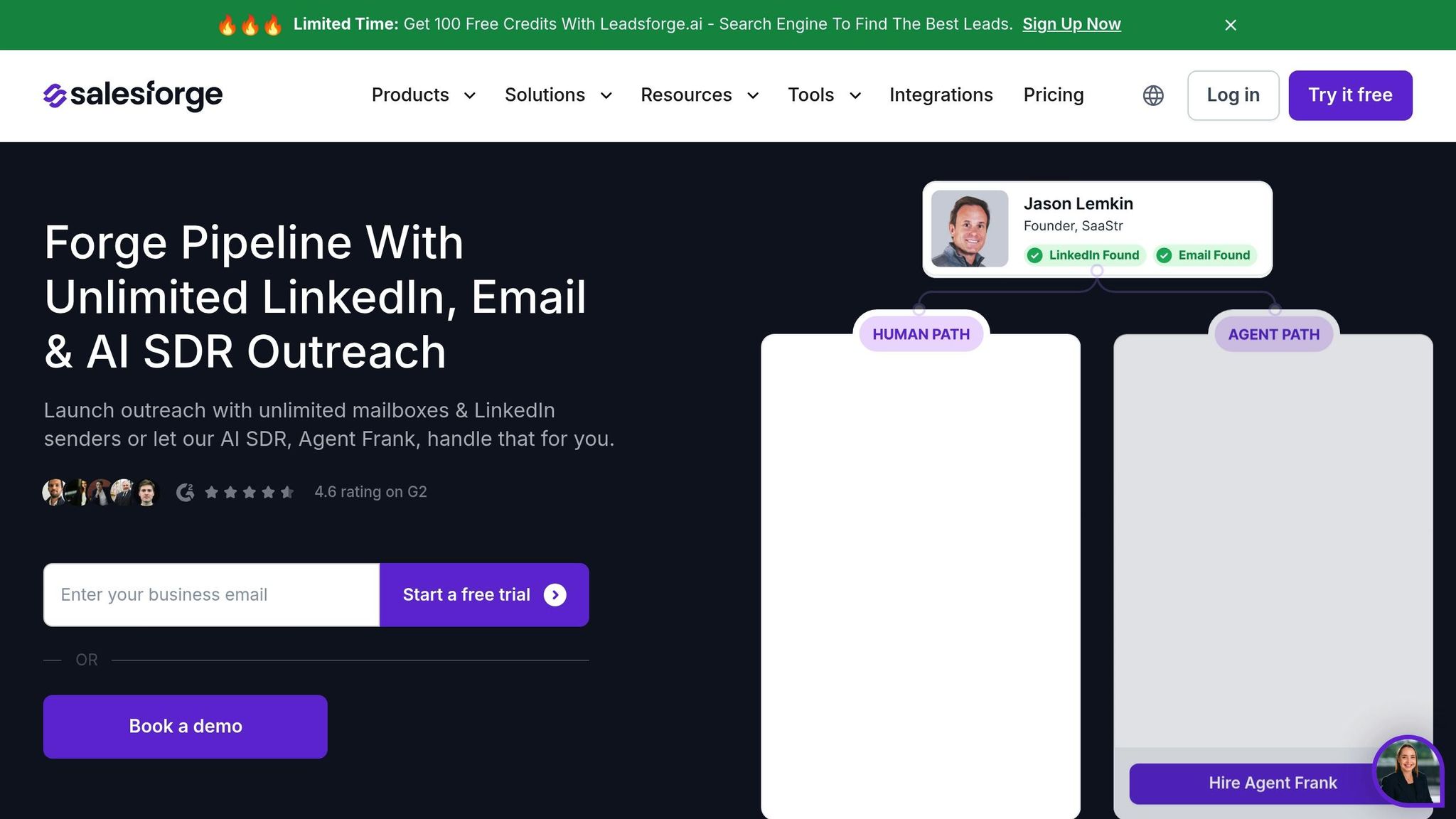
Salesforge is built with features specifically designed to meet GDPR requirements, ensuring your data remains secure and compliant. The platform operates with a clear division of roles: you are the Data Controller, managing and owning your contact lists, while Salesforge acts as the Data Processor, handling data on your behalf. All databases are stored within the European Union, simplifying any concerns around cross-border data transfers. For customers in the EU, Salesforge also offers a Data Processing Addendum (DPA) that complements its Terms of Service and Privacy Policy.
Handling data subject requests is seamless with Salesforge. The platform acknowledges receipt of requests within 72 business hours and completes processing within 30 days. It supports key GDPR rights - such as access, rectification, erasure, data portability, and the right to object - through self-service tools available in the Settings menu. Additionally, users can easily export contact lists with the click of a button.
Salesforge’s Primebox™ feature consolidates email and LinkedIn replies into a single dashboard, simplifying the management of opt-outs and data subject requests. Meanwhile, Warmforge, included with every Salesforge subscription, uses a secure, closed pool of internal mailboxes to build sender reputation. This reduces reliance on third-party SMTP providers, offering an added layer of protection.
Regarding data retention, Salesforge limits storage to what’s necessary for its services. Personal data is generally retained for no more than three years after account closure or the last active contact with marketing prospects.
These features provide a strong foundation for GDPR compliance, setting Salesforge apart from other AI sales tools.
While many AI sales platforms offer basic GDPR compliance, Salesforge takes it further with its thoughtful design and adaptability. Unlike competitors that rely on traditional seat-based pricing, Salesforge’s usage-based pricing allows you to connect unlimited mailboxes and LinkedIn senders without adding complexity to compliance management.
Salesforge not only meets GDPR standards but also ensures high performance for outreach campaigns. Features like Primebox™, which centralizes consent and opt-out management, and Warmforge, which securely warms up email accounts, strengthen data protection across multiple channels. This combination creates a well-rounded, GDPR-compliant solution tailored for modern multi-channel outreach.
GDPR compliance goes far beyond being just a legal requirement for AI sales tools - it’s a way to build trust with your customers while protecting your business from hefty financial penalties. Recent high-profile GDPR fines serve as a stark reminder of the risks involved in non-compliance, as regulators increasingly use advanced tools to scrutinize data practices.
But the impact isn’t just about avoiding fines. Nearly half (48%) of consumers have switched companies due to concerns over how their data was handled. This makes compliance a key factor in retaining customers and maintaining brand loyalty. Experts stress that being transparent and offering clear opt-out options are essential steps in earning trust. The shift toward explicit consent is gaining momentum, with opt-in models expected to dominate B2B outreach by 2025, replacing the more lenient "legitimate interest" exemptions.
To stay ahead, it’s crucial to integrate compliance into your outreach strategy. When selecting an AI sales tool, choose platforms that prioritize compliance features. Look for capabilities like automated data subject request handling and easy-to-use unsubscribe options. For instance, tools like Salesforge combine compliance with performance, offering features such as Primebox™ for centralized consent management and Warmforge for secure email warming - all while adhering to strict GDPR standards.
When selecting an AI sales tool, it's crucial to ensure it aligns with GDPR requirements. Start by checking for features like consent tracking - this helps document when and how prospects gave their permission or how a legitimate interest was established. The tool should also simplify managing opt-outs, handling data deletion requests, and providing clear, transparent disclosures about data collection and usage.
Another must-have is robust data security measures. Look for tools that include encryption, email authentication protocols like SPF, DKIM, and DMARC, as well as access controls to safeguard personal information. Additional features such as automated data minimization, customizable retention policies, and tools for managing data subject requests - whether for access, correction, or deletion - are essential for staying GDPR-compliant. Platforms like Salesforge integrate these capabilities with AI-powered sales automation, allowing for efficient outreach while maintaining privacy standards.
To meet GDPR requirements, businesses must secure explicit consent from individuals before handling their personal data. This means consent must be clear, specific, freely given, and fully informed. For instance, avoid using pre-checked boxes or vague language. Clearly outline what data will be collected, why it’s needed, and who will have access to it.
Here’s how to ensure compliance:
Incorporating these steps into your sales process - whether through tools like Salesforge for AI-driven outreach or other platforms - can help you stay compliant, safeguard user privacy, and build trust while steering clear of GDPR penalties.
Using AI for behavioral profiling in sales outreach comes with significant GDPR challenges. Since AI-driven profiling falls under automated decision-making as defined by GDPR, individuals have specific rights. These include understanding how their data is processed, disputing decisions, and opting out of profiling that may have serious effects on them. Without clear transparency, a legitimate legal basis (like consent or legitimate interest), and proper safeguards, companies could find themselves in violation of GDPR. The penalties? Fines of up to €20 million or 4% of global revenue - whichever is higher.
AI tools often aggregate data from various sources, which can unintentionally lead to processing sensitive information without proper legal grounds. This not only risks creating biased or inaccurate profiles but also breaches GDPR’s fairness principles, opening the door to complaints or regulatory scrutiny. To avoid these pitfalls, businesses need to take proactive steps: conducting Data Protection Impact Assessments (DPIAs), keeping thorough records, and ensuring individuals can exercise their rights, such as requesting data access or deletion. Ignoring these obligations doesn’t just invite legal trouble - it can erode customer trust, tarnish reputations, and disrupt sales efforts.
.jpg)



.jpg)