The inbound sales strategy most revenue teams still run was built for a buyer who no longer exists. In 2018, a blog post brought in traffic, a form fill flagged intent, and sales walked into a conversation with something to say. That motion worked. It does not work now. Most of the pipeline I watch close today starts before anyone fills out a form, and most inbound teams still have no idea it is happening.
This blog is for revenue leaders who sense the gap and want a cleaner frame for it. I will walk through what inbound sales actually means in 2026, why the old setup stalls, and what a signal-driven inbound sales strategy looks like when it is built the right way.
Inbound sales is the motion where the buyer moves first. They read, compare, ask peers, and form a shortlist before talking to a vendor. Sales enters late, with context, and tries to help the buyer finish what they already started. That definition has not changed. What has changed is how invisible most of that motion is to the seller.
The numbers tell the story cleanly. B2B buyers now complete roughly 70 to 80% of their research before speaking to sales. Around 96% research vendors on their own. Only about 5% of a category is actively in-market in any given quarter. If your inbound engine only reacts to form fills, you are competing for a sliver of a sliver, and you are arriving late to that sliver.
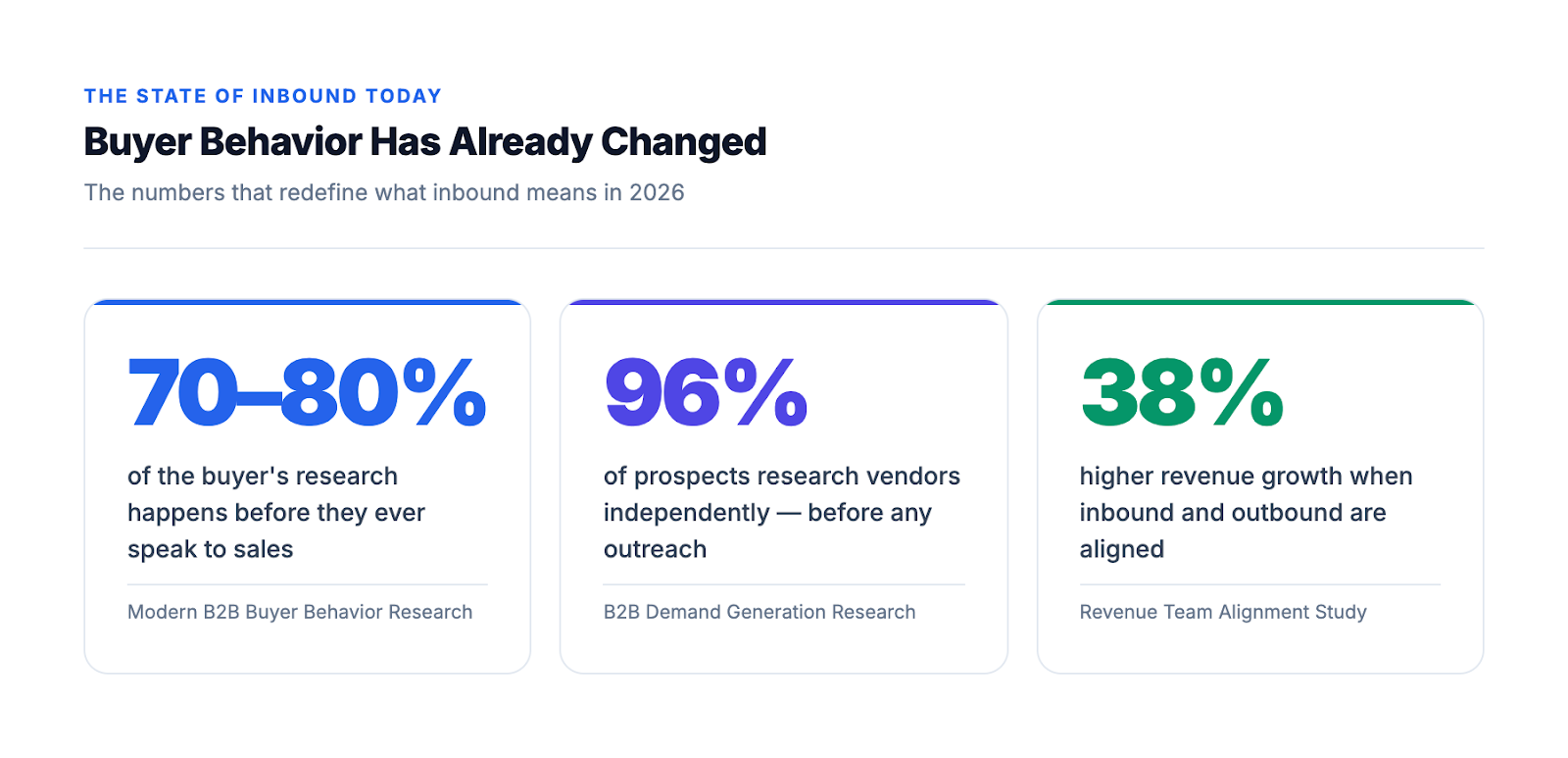
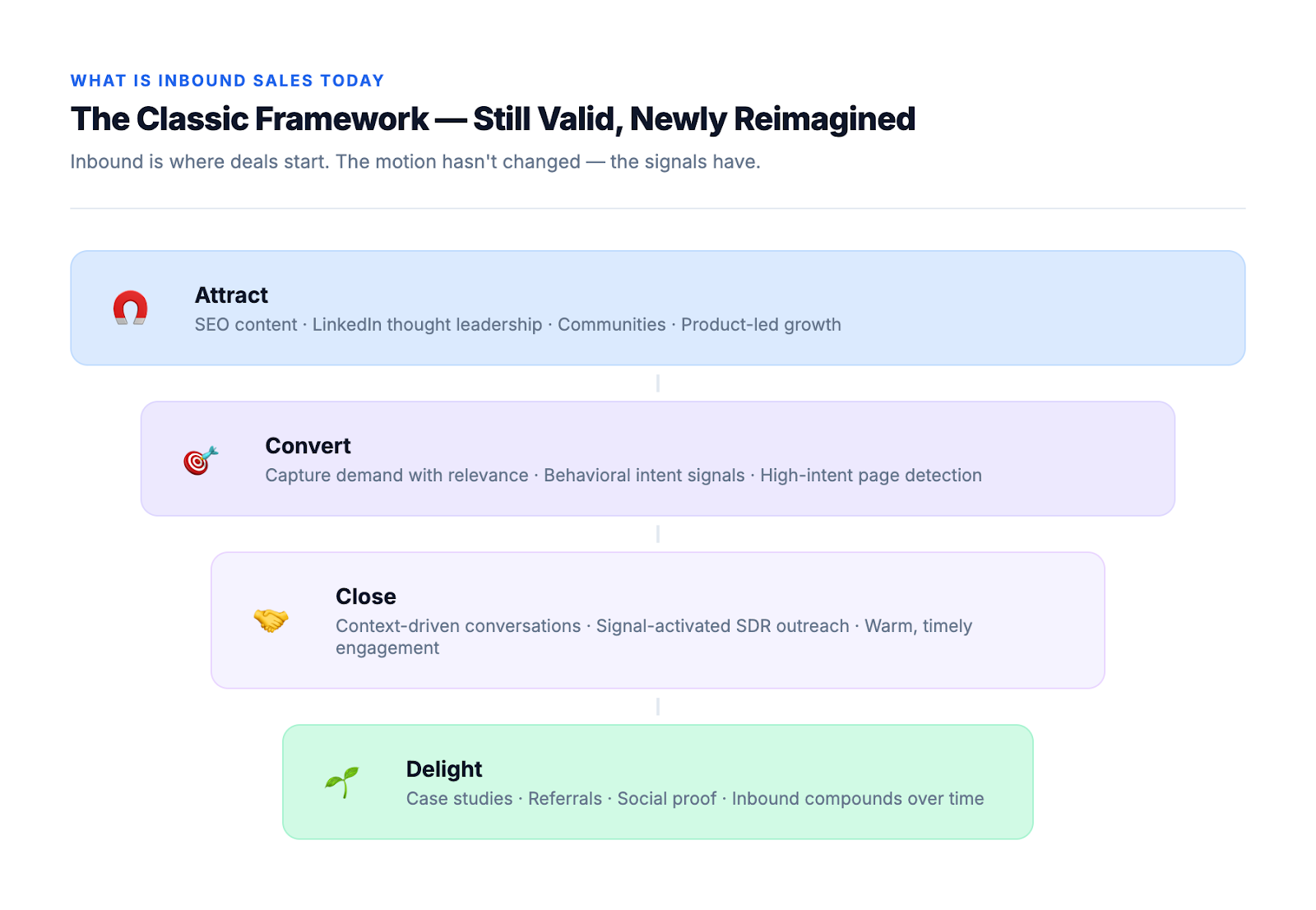
The old framing of Attract, Convert, Close, Delight still describes the shape of the journey. What it hides is that the Attract and Convert stages used to be visible to marketing. Today most of the buying research happens on third-party sites, inside Slack communities, in peer conversations, and on pages you do not own. You cannot attract what you cannot see, and you cannot convert what you did not know was happening.
That is why inbound in 2026 is less about owning the funnel and more about reading the market. The teams doing this well spend less effort on form design and more on signal infrastructure.
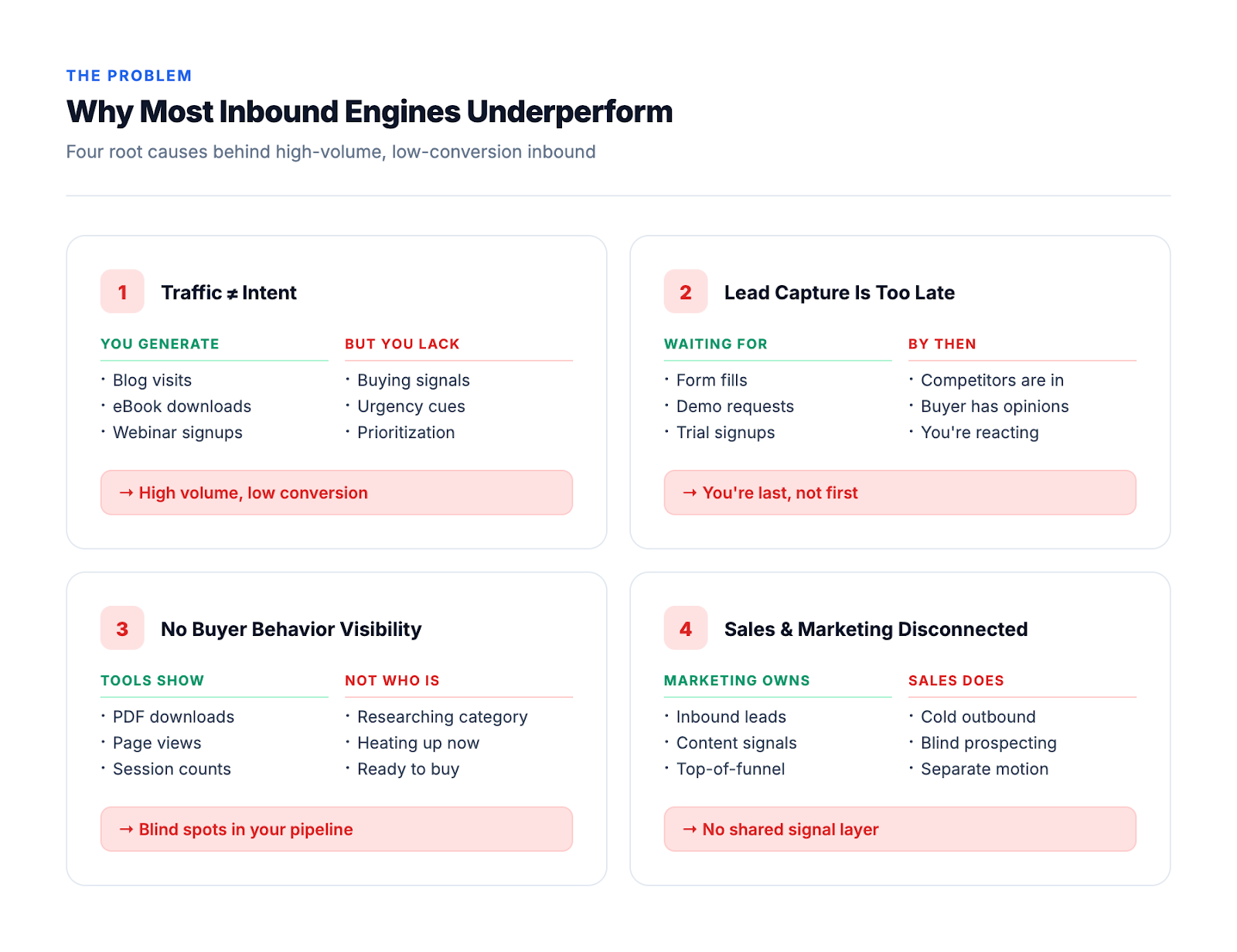
I see four failure points show up again and again, no matter the team size or the tech stack.
Blog visits, ebook downloads, and webinar signups get reported as demand. They are not. A download is a curiosity signal at best. The person might be a student, a competitor, a freelancer studying the space, or a buyer who is twelve months away. Treating volume as pipeline is how SDR teams end up spending their mornings on lists that go nowhere.
By the time someone fills out a demo form, the deal is already shaped. The buyer has picked two or three vendors, read comparison pages, watched a YouTube review, and formed opinions about pricing and positioning. Sales walks into a conversation where the anchors are already set. That is not inbound working. That is inbound arriving at the finish line with nothing to say.
Most inbound tools can tell you that someone downloaded a PDF. They cannot tell you which accounts are heating up across your category, which buyers keep returning to the pricing page, or which companies are researching a problem your product solves. You end up reacting to individuals when you should be tracking accounts.
Inbound sits inside marketing dashboards. Outbound sits inside sales dashboards. Both teams rarely see the same view of the same account. A prospect reads three of your articles, attends a webinar, and lands on the pricing page. Marketing logs it as engagement. Sales has no idea and keeps sending cold sequences to the same contact. Research has consistently shown that teams combining inbound and outbound around a shared signal layer grow faster than teams that keep the motions separated.
The real issue is not which channel wins. It is that both channels are flying blind to the same buyer.
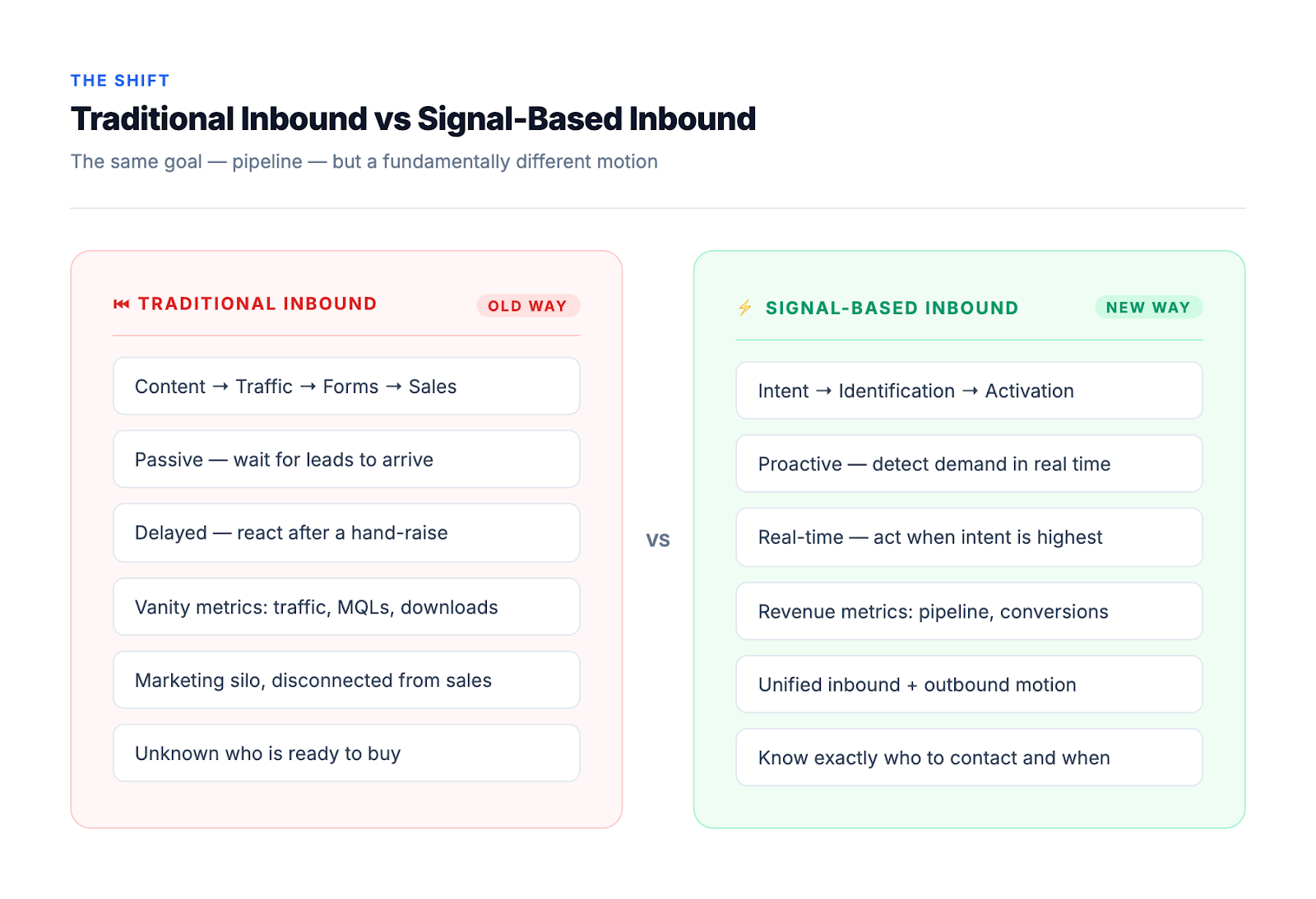
Funnel-based inbound waits. Content brings traffic, traffic becomes forms, forms become leads, leads get routed. Every stage is delayed, every stage loses data, and every stage depends on the buyer raising a hand. Signal-based inbound does the opposite. It reads buyer behavior early, identifies accounts showing intent, and gives sales a reason to reach out before the form fill.
The difference is not a tool swap. It is a redesign of what the motion is for. Here is how the two frames compare side by side.
A working system has three layers that feed into each other. Miss one and the whole thing degrades into a content calendar with a sales team attached.
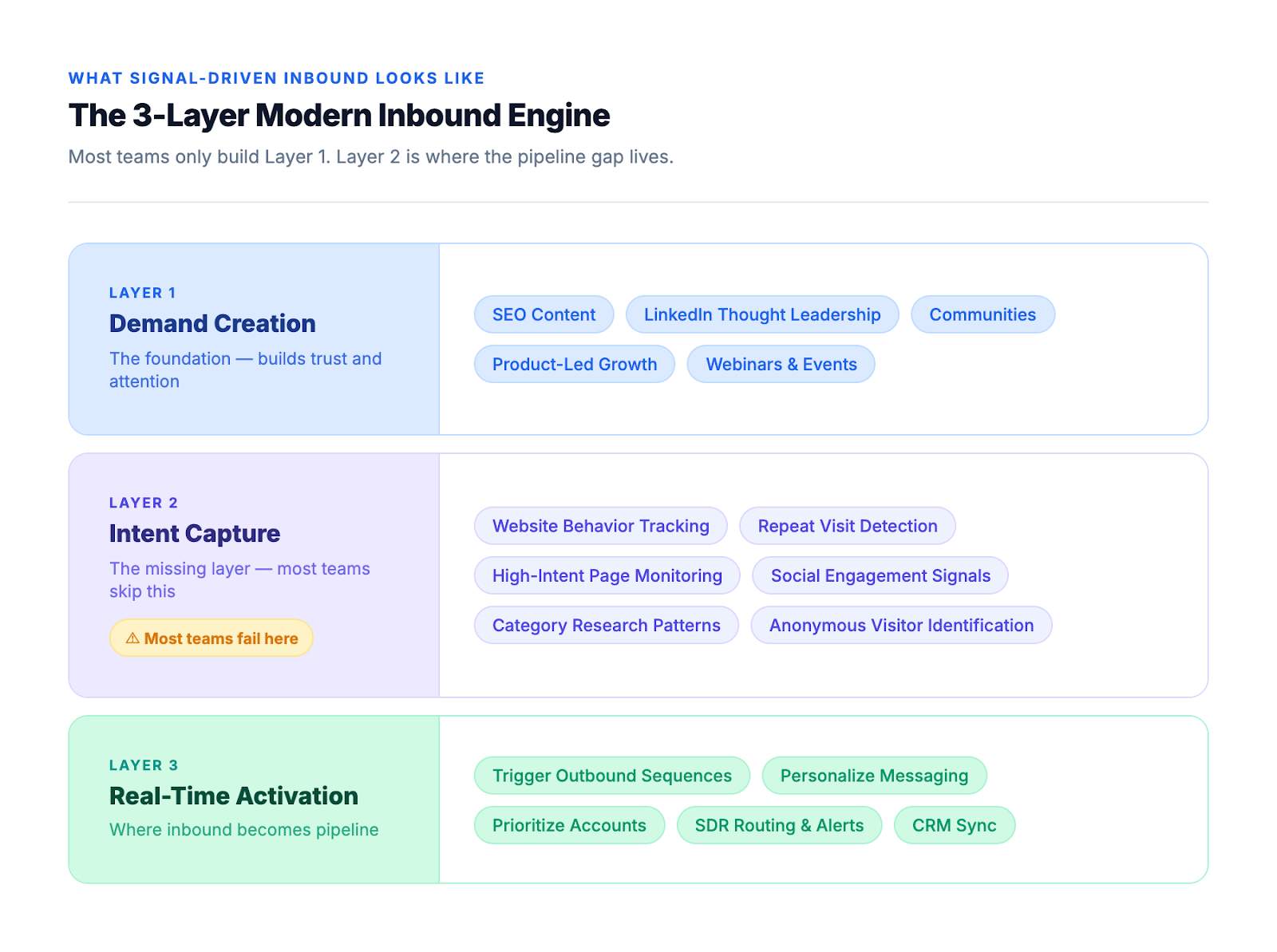
This is still the core of inbound. SEO content that answers real buyer questions, thought leadership on LinkedIn from operators who have actually done the work, presence inside the communities where your buyers hang out, and product-led touches that let prospects experience value before a call. This layer builds the surface area where signals eventually appear. Without it, there is nothing to detect.
This is the layer most teams skip. It turns anonymous activity into identifiable accounts, and it watches behavior across more than just your own site. A few examples of what intent capture actually looks like when it is done well:
None of these require the buyer to fill out a form. All of them are stronger purchase signals than an ebook download.
From there, the signal drives the outreach. If the account has been active on your pricing page, an email lands referencing the exact problem that page solves. If a decision maker engaged with your content on LinkedIn, a LinkedIn touch goes out from the right rep. I run Salesforge on the outbound side for this, because it lets me fire email and LinkedIn from the same sequence with the automatic follow-ups. The signal tells me who to reach and when. Salesforge is the engine that actually reaches them
Inbound teams get the content engine right and lose the deal anyway. The demand creation layer is usually already in motion. The detection and activation layers are where the pipeline leaks. That is the gap I built OmniSignal to close, because the second and third layers are where most teams are exposed.
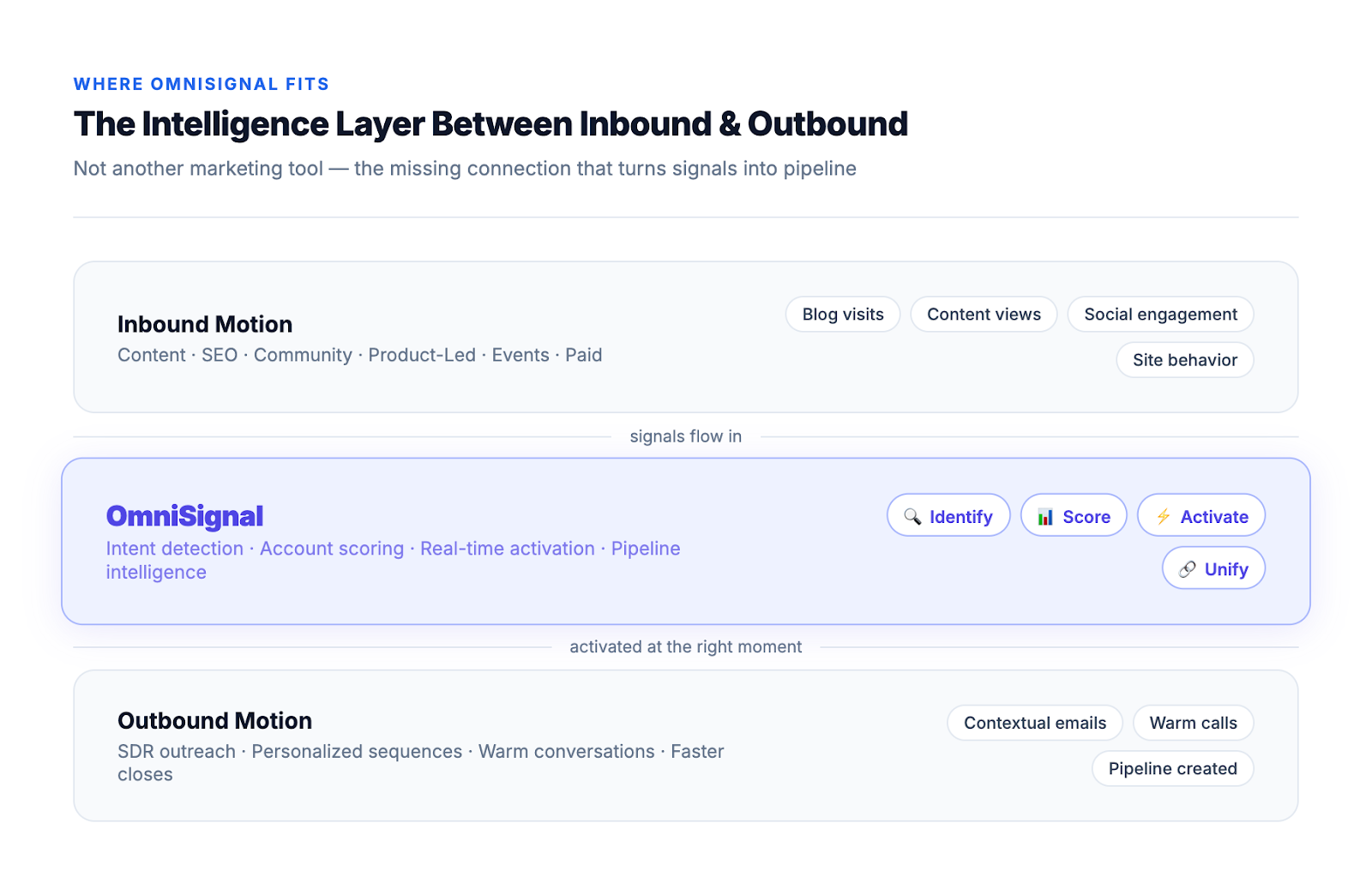
Instead of reporting anonymous sessions, OmniSignal identifies the real accounts visiting your site and engaging with your content. That includes accounts that never fill out a form, which in most B2B funnels is the majority of serious buyers.
Not every signal is worth a meeting. A single visit to your homepage is different from three returning sessions to your pricing page in a week. OmniSignal scores signals so SDRs and AEs know which accounts are genuinely heating up and which are background noise. This is where a lot of wasted SDR time gets reclaimed.
When an account crosses a threshold, OmniSignal triggers the right motion. That might be an SDR task with full context, a personalized email with references to what the account actually engaged with, or a LinkedIn touch from the account owner. Inbound stops being about waiting. It becomes about timing.
The biggest shift is that marketing and sales finally see the same account, the same behavior, and the same signal strength. One system, one signal layer, one pipeline engine. This is where the old inbound-versus-outbound argument dissolves, because both motions are now working off the same live view of who is in market.
If I had to rebuild an inbound motion from scratch today, this is the sequence I would follow. It is not a theory. It is how I watch the teams who are actually pulling this off structure their work.
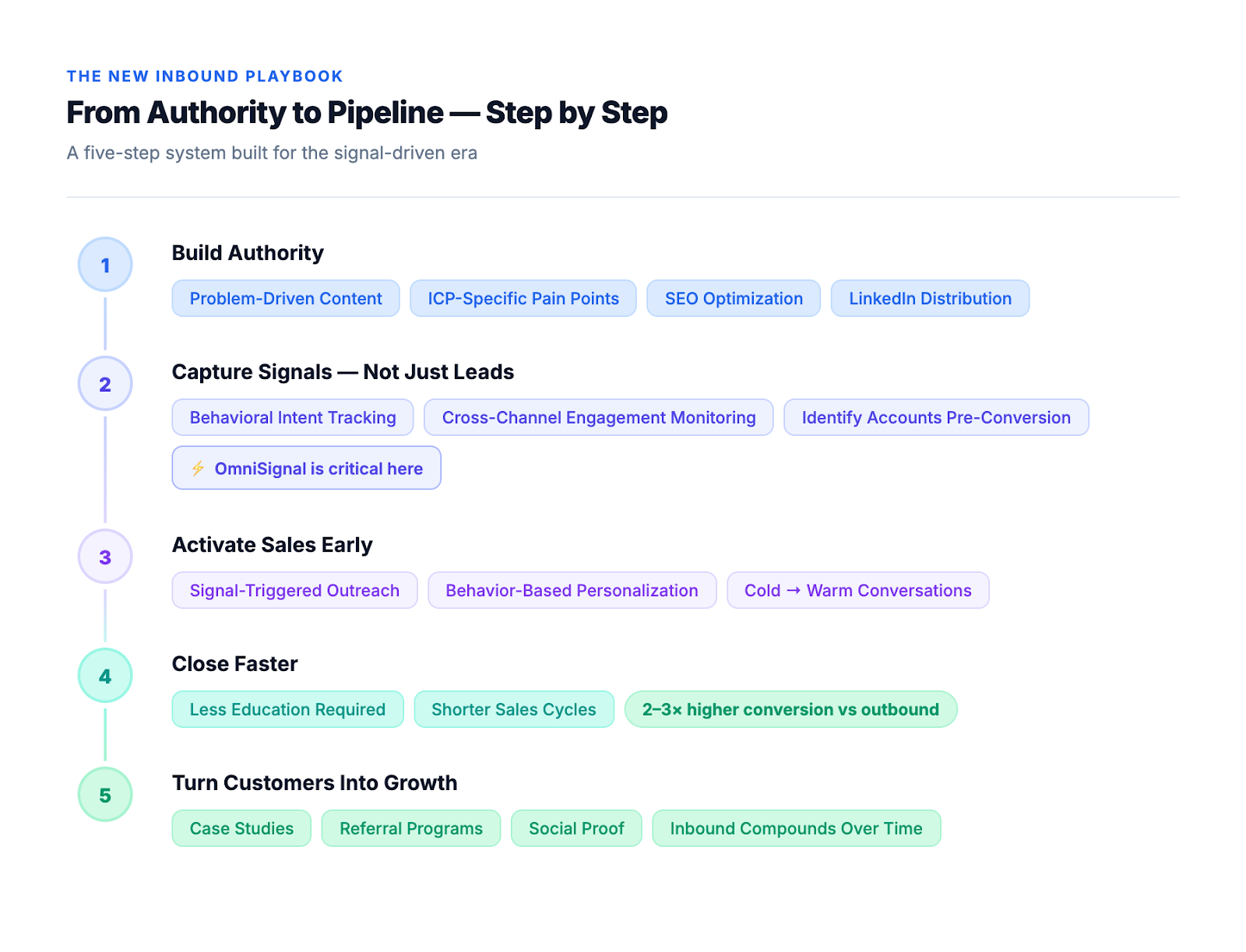
Generic content is dead. The content that compounds is specific to a role, a workflow, or a pain. Write about the problem your buyer is stuck on, not the category you belong to. Then optimize for discovery in search, in LinkedIn, and increasingly in AI assistants, because more buyers now start their research inside tools like ChatGPT and Perplexity before they ever hit Google.
Set up identification on your site. Track account-level behavior across your key pages. Watch engagement on your content across LinkedIn. Pull in category-level intent data for the topics that matter to your buyer. The goal is to know which accounts are in motion, even when no one has raised a hand. This is the step that separates a modern inbound engine from a 2018 funnel.
Route high-intent accounts to sales the moment they cross a threshold. Give reps a one-paragraph brief on what the account looked at, what changed at the company, and what the right opening angle is. Replace cold sequences with contextual ones. The account may still not be ready for a demo, but the conversation will start warmer, and the response rates will reflect that.
Inbound-qualified leads historically convert two to three times higher than cold outbound, require less education, and move through the cycle faster. The reason is simple. They were already researching. When sales shows up with context instead of a pitch, the cycle compresses further. The signal layer is what gives sales that context at the moment of first contact.
Case studies, referrals, and social proof are not afterthoughts. They are the distribution for the next round of demand creation. Your best inbound signals will come from communities where your customers already speak about the problem. The engine compounds when you feed it with customer voices instead of brand copy.
Every year someone declares one of the two dead. Every year both keep working. The teams I respect stopped picking sides and started building systems where the two motions share a signal layer. Outbound creates demand by starting conversations with accounts that fit the ICP but have not shown intent yet. Inbound captures and converts that demand when it appears. Signals are the connective tissue between them.
When the two motions run on the same view of the same account, something quiet happens. SDRs stop emailing buyers who are already deep in research with a competitor. Marketing stops celebrating MQLs that sales already closed elsewhere. Reporting finally reflects what actually drove pipeline. The inbound-versus-outbound argument gets replaced with a better question: which account is in motion, and what is the right next touch?
If I had to reduce this piece to one line, it would be this. Inbound does not need more traffic. It needs better timing. Every company I have watched rebuild their pipeline in the last two years has done less publishing, less list-building, and more signal work. The teams winning in 2026 are the ones who treat inbound as a revenue system rather than a content strategy. That is the only version of inbound that keeps working when buyer behavior keeps changing
Inbound sales is triggered by buyer behavior. Outbound sales is triggered by seller action. In 2026 the line blurs, because a signal-driven inbound engine will often trigger what looks like outbound outreach, but the timing is guided by real buyer intent. The better question is not which motion you run. It is whether both motions share the same view of the account.
Form fills only capture the small fraction of buyers willing to raise a hand. The majority of B2B buyers research quietly, consume content on third-party sites, and form shortlists before any form is submitted. Teams that rely only on forms miss most of the real pipeline because they never see it moving.
Strong signals combine behavior with context. Examples include repeat visits to pricing or comparison pages from the same account, a decision maker engaging with your content on LinkedIn, category-level research spikes, and trigger events like a funding round or new executive hire. A single page view is a weak signal. A pattern of behavior from a named account is a strong one.
No. Content is the surface area where signals appear. The shift is not away from content, it is toward instrumenting the content so you can see which accounts are engaging and act on it. Teams that kill their content engine before fixing their signal layer usually end up worse off.
The timing piece usually shows up first. SDRs start getting warmer replies within weeks because outreach is finally timed to real buyer activity. Pipeline compounding takes longer because it depends on how much demand creation the team had in flight already. A team with existing content will see results faster than a team starting both layers at once.